|


|
Dan Kurland began carving as an avocation in the mid-1960s, while editor-in-chief of a major New York publishing house. He continued to carve in his spare time during subsequent careers as a machinist, college English professor, Assistant to the Chaplain at Johns Hopkins University, and middle school math/science teacher on the Hopi reservation. In the mid-1980s he moved to Austin, Texas, where he took up carving full-time. He taught stone carving at the Elisabet Ney Sculpture Conservatory and exhibited in numerous shows and galleries in the Austin-Dallas-Houston-San Antonio area. In 2003 he moved to Charleston, West Virginia, where he worked as a health care advocate/lobbyist for a social justice organization and exhibited in a local co-op gallery. He moved to Tallahassee in 2008.
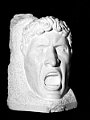
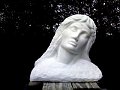
Kurland is self-trained. He learned through practice and the study of works in galleries and museums in New York City, Milan, Rome, and Florence. He works mostly in limestone and marble, at times in sandstone, alabaster, or wood. And he works the old-fashioned way -- almost exclusively with hammer and chisel, only recently with pneumatics. Throughout his career he has focused predominantly on figurative works, initially in a classical style and later in a more primitive vein. His more realistic renderings explore the full variety of the human aesthetic rather than pursuing an idealized form. He generally works directly in the stone, eschewing drawings and maquettes, and always tries to remain true to the original material, varying subject matter, design, and technique to fit the physical characteristics (color, texture, and imperfections) of the individual stone.
Carving, as he does it, is an act of discovery as much as of creation. That is not to say that the artist does not attempt to instill/evoke meaning or emotion in a piece; he/she simply cannot legislate it, and may not even be consciously aware of his/her intentions. Any assertion of meaning in a work lies in the province of the viewer, not the artist. A piece means what you think it means. The best art is often ambiguous and thought provoking, unsettling and enigmatic. It forces reflection and self-examination. Its true value lies in the dual experiences of creation and viewing, not in its being in itself. Finally, art, like life, is a serious endeavor, but it should not be taken too seriously.
|
|
|
| Total images: 74 | Create web photo albums with Jalbum | Chameleon skin | Help |